
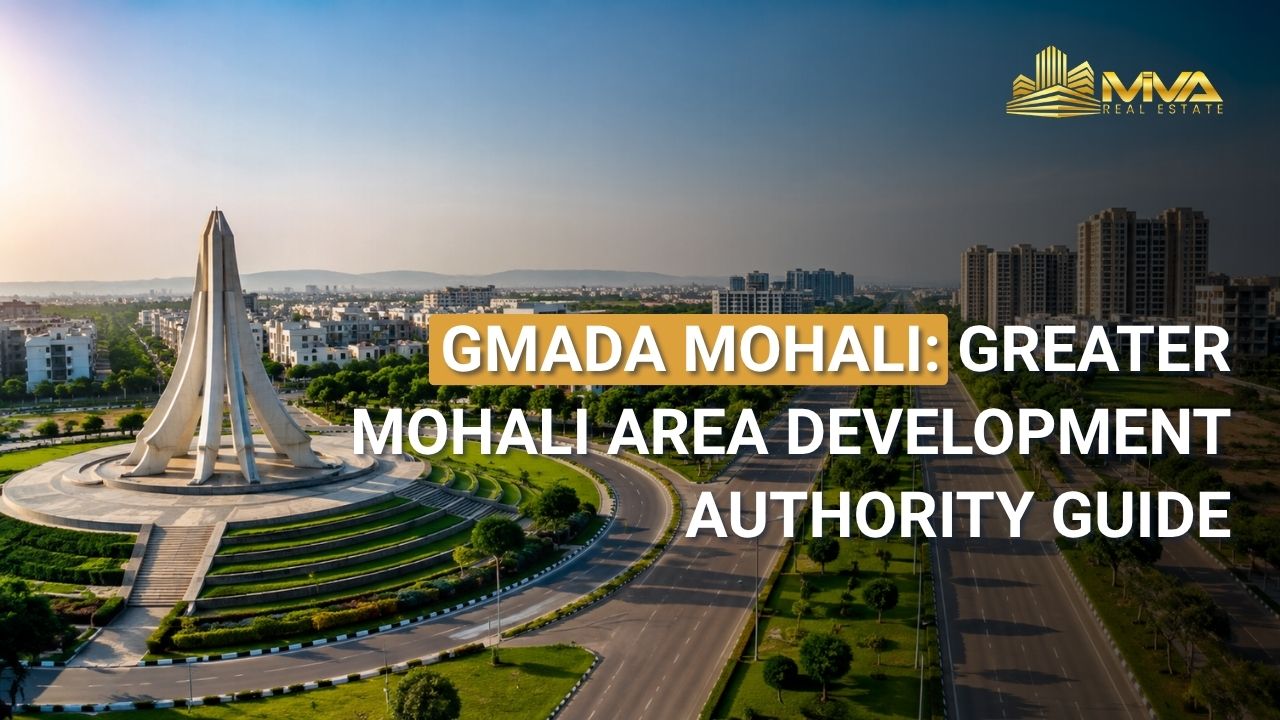

Buying a plot is not only about choosing the right location. Buyers also need to understand how the area is planned, whether the property records can be verified, what development is taking place around it and which authority oversees the process.
This is where GMADA becomes important for anyone exploring property in Greater Mohali. From established sectors to growing areas such as Aerocity, New Chandigarh and Eco City, GMADA plays a significant role in how planned development takes shape across the region.
This is where GMADA becomes important for anyone exploring property in Greater Mohali. From established sectors to growing areas such as Aerocity, New Chandigarh and Eco City, GMADA plays a significant role in how planned development takes shape across the region.
What is GMADA?
GMADA stands for Greater Mohali Area Development Authority. It is a development body which was constituted on 14 August 2006, under Section 29(1) of the Punjab Regional and Town Planning Act, 1995, by the Punjab Government.
GMADA stands for Greater Mohali Area Development Authority. It is a development body which was constituted on 14 August 2006, under Section 29(1) of the Punjab Regional and Town Planning Act, 1995, by the Punjab Government.
Why was GMADA Created?
Before 2006, the land around Mohali was mostly agricultural, thus whatever housing came up did in an unplanned way with colonies without a proper layout, roads, no defined drainage or long-term thinking about other establishments and facilities.
So, Punjab needed a dedicated authority which could plan the region, making it completely functional rather than going plot by plot.
The state, then using the powers of the Punjab Regional and Town Planning and Development Act, 1995, carved GMADA particularly for the Greater Mohali belt.
The authority is chaired by the Chief Minister of Punjab, heading three working committees: the executive committee, the planning and design committee and the budget and accounts scrutiny committee, each handling a different layer of responsibility, decision-making and long-term planning.
GMADA’s jurisdiction is not just limited to Mohali city but also covers Mohali, Banur, Zirakpur, Derabassi, Kharar, Mullanpur (New Chandigarh), Fatehgarh Sahib, Mandi Gobindgarh and Rupnagar, making the entire belt a high-growth corridor and one of North India’s active real estate markets.
PUDA vs GMADA: What’s the Difference?
One of the most common points of confusion among first-time buyers is the difference between PUDA and GMADA. PUDA is the state-level apex body, governing and guiding planned urban development across the state.
GMADA, on the other hand, is one of the regional authorities working under the framework of PUDA, focused specifically on the Greater Mohali region, similar to GLADA for Ludhiana and ADA for Amritsar.
| Aspect | PUDA | GMADA |
|---|---|---|
| Full Form | Punjab Urban Planning and Development Authority | Greater Mohali Area Development Authority |
| Established | 1 July 1995 | 14 August 2006 |
| Coverage | Entire state of Punjab | Mohali, Zirakpur, Kharar, Derabassi, New Chandigarh and nearby areas |
| Role | State-level apex policy and coordination body | Regional, ground-level planning and plot allotment authority |
| Governing Act | Punjab Regional and Town Planning and Development Act, 1995 | Same Act, Section 29(1) |
| Head Office | PUDA Bhawan, Sector 62, SAS Nagar | PUDA Bhawan, Sector 62, SAS Nagar |
Both authorities share a common office building at PUDA Bhawan, Sector 62, SAS Nagar. But if you are buying in Mohali, Zirakpur, Kharar or New Chandigarh, GMADA is the relevant regional development authority for many planning, allotment and property-related matters within its notified jurisdiction.
How GMADA Works
GMADA’s work goes way beyond selling plots. It is meant for planned urban development of the Mohali region, with clear titles, pre-approved land use and developed infrastructure in place before a plot ever reaches the market.
This structured plan is actually why GMADA-approved plots in Mohali hold a more premium market over comparable private colonies.
The process typically looks like this:
- GMADA drafts a master plan for a town or a sector, years in advance, zoning residential, commercial, institutional and green areas.
- Land is acquired through direct purchase, formal acquisition or increasingly through the land pooling scheme, where landowners voluntarily contribute land in exchange for developed plots.
- Roads, sewerage, water supply and horticulture works are tendered and built under GMADA’s supervision.
- Once basic infrastructure is functional, plots go out to the public through a computerised draw or, more commonly now, a transparent online e-auction.
- Buyers sign an allotment letter, pay in installments or as a lump sum and eventually receive a conveyance deed once dues are cleared.
Each stage follows a documented process, giving buyers greater transparency and making GMADA plots a more secure option than land in unauthorised private colonies.
How GMADA Safeguards Homebuyers
This is the part that matters the most once real money is on the table; no one wants a disputed piece of land when they have invested their life’s savings to get it.
Here’s how GMADA Mohali provides structural protection to buyers:
- Documented allotment and ownership records: The land has already been through acquisition and pooling formalities before it reaches the buyer.
- Planned land-use designation: Residential, commercial, institutional and other uses are governed by notified planning frameworks and applicable approvals.
- Infrastructure development: Infrastructure is developed prior to or alongside plot handover.
- Grievance redressal: A grievance redressal system, including public hearings, is available for resolving complaints.
- Regulated transfer process: Permission for sale, gift or will execution is tracked through official channels.
- Verified auction process: Official auctions run through verified government platforms, allowing buyers to confirm whether a scheme is genuinely from GMADA.
GMADA Know Your Property: How to Check Before You Buy
One of the most useful tools GMADA offers is the Know Your Property facility. It allows you to look up a plot’s ownership records, allotment status, dues and transaction history directly on GMADA’s citizen services portal.
Before finalising any GMADA plot, it is worth using this to confirm:
- The current registered owner and allotment status of the plot.
- Whether any dues, instalments or penalties are outstanding against it.
- The unique property number (UPN) and basic ledger details tied to the site.
Before purchasing a resale GMADA property, use the official property services available through GMADA/PUDA to cross-check the available property and allotment information.
Buyers should also independently verify title documents, outstanding dues, transfer conditions and the seller’s authority to complete the transaction.
How GMADA Handles Defaulters
The Greater Mohali Area Development Authority (GMADA) takes non-payment seriously and takes strict actions against defaulters including builders and property allottees.
Penalties and consequences can vary depending on the type of property, allotment terms, outstanding amount and applicable GMADA policy.
Buyers and allottees should check their allotment conditions and current official notices for the applicable interest, penalty or recovery provisions.
GMADA New Plots Scheme: What Types of Properties Are Offered?
Over the years GMADA has released a wide range of residential and commercial products across its jurisdiction.
| Plot Category | Typical Use | Common Zones |
|---|---|---|
| Residential plots | Independent housing, group housing sites | Mohali sectors, Eco City, Aerotropolis |
| Commercial SCO / Booths | Shops, showrooms, offices | Aerocity, sector commercial belts |
| Institutional sites | Schools, hospitals, colleges | New Chandigarh, Aerotropolis |
| Industrial / mixed-use | Business parks, light industry | IT City, Aerotropolis |
Freehold vs Leasehold Plots
One question that comes up in almost every buyer conversation: what is the difference between leasehold and freehold?
A freehold plot provides permanent ownership rights to the owner, with no time limit, complete rights to sell, transfer or mortgage.
A leasehold plot, on the other hand, is allotted for a fixed term, commonly 99 years under GMADA, after which renewal or conversion terms apply.
Most recent GMADA residential and commercial allotments have moved towards freehold-style conveyance once dues are cleared, but it’s always better to check the specific allotment letter for the project before you sign.
GMADA Eco City: Planned Green Living in New Chandigarh
Among GMADA’s most popular residential launches are GMADA Eco City 1, GMADA Eco City 2, GMADA Eco City 3 and GMADA Eco City 4, developed around a broader vision to build self-sustaining, medium-density townships that keep green cover intact while still delivering full city infrastructure.
New Chandigarh’s underlying road network was planned on a grid-iron pattern: arterial roads sixty metres wide, collector roads at forty-five metres and primary roads at thirty metres, designed to keep the area from feeling congested even as more sectors get built out.
GMADA Eco City 2 followed as a larger, next-generation township spread across several villages, built on the same land pooling model, with infrastructure works progressing alongside plot allotments.
GMADA Eco City 3 has been active in land pooling schemes recently, with landowner forms and plot-size public notices circulating through 2025 and land acquisition reported complete by December 2025.
GMADA Eco City 4 has also been proposed with land acquisition initiated in June 2026.
For homebuyers, the Eco City townships appeal because they combine GMADA’s planning discipline with planned residential development and an emphasis on open and green spaces, a rare pairing this close to Chandigarh.
GMADA Aerocity and Aerotropolis Mohali: Where Connectivity Meets Planned Growth
GMADA Aerocity and its larger extension, Aerotropolis Mohali, are two of the most popular GMADA zones.
Spread across roughly 5,500 acres on both sides of the Zirakpur–Banur road, close to Shaheed Bhagat Singh International Airport, Aerocity Mohali is being developed on the same airport-led urban growth model seen in aerotropolis projects worldwide.
The larger township is divided into nine pockets (A through I), with the first development phase focused on pockets A, B, C and D, roughly 1,650 acres.
GMADA has already issued work orders worth close to ₹509 crore for internal roads and core infrastructure across pockets B, C and D, awarded to a joint venture, with completion targeted around early-to-mid 2026.
| Detail | Figure |
|---|---|
| Total planned area | Approximately 5,500 acres |
| Number of pockets | 9 (Pocket A to Pocket I) |
| Phase 1 area | Approximately 1,650 acres |
| Location | Near Shaheed Bhagat Singh International Airport, Zirakpur–Banur Road |
| Development model | Land pooling, with plots to landowners and remaining inventory sold via e-auction/draw |
Under the land pooling policy, landowners whose farmland was contributed to Aerocity Mohali receive developed residential or commercial plots in proportion to their land, while the remaining plots go into GMADA’s inventory for public allotment.
This has become GMADA’s preferred way of acquiring large tracts of land for new townships, because it keeps original landowners invested in the outcome rather than treating land acquisition as a one-time payout.
New Chandigarh: Building a New Urban Identity
New Chandigarh, also known as Mullanpur, has emerged as one of GMADA’s key development areas, encompassing Eco City, Medi City, Edu City and Knowledge City.
New Chandigarh combines planned residential development, institutional zones, open spaces and connectivity with Chandigarh and the wider Mohali region.
Kurali and Gharuan: The Upcoming Townships
Kurali and Gharuan are emerging as part of GMADA’s wider development focus around Greater Mohali.
Their location along important regional routes and proximity to established urban and institutional areas are bringing these locations into the region’s expanding development landscape.
Kurali benefits from road connectivity towards Mohali, Ropar and Ludhiana, while Gharuan is positioned near educational institutions and developing residential corridors.
As planning activity progresses, both areas could contribute to the next phase of residential and mixed-use development beyond Mohali’s established sectors.
For buyers, however, these are still developing locations. Infrastructure progress, approved land use, scheme status and individual property documentation should be verified before making a purchase decision.
Beyond Chandigarh: The Rise of Zirakpur, Kharar and Derabassi
With other townships under GMADA getting continuous spotlight, GMADA’s work in Kharar, Derabassi and Zirakpur supports Tricity’s housing demands at affordable rates.
These towns have key connectivity with Chandigarh, Ambala and Panchkula, and they have become an attractive option for residential and commercial investors who can take advantage of GMADA’s planned jurisdiction with lower entry prices than Mohali.
GMADA Land Pooling: A Collaborative Approach to Urban Development
GMADA’s land pooling model allows eligible landowners to contribute land for planned development and receive developed plots or other benefits based on the terms of the specific scheme.
The model has been used in development areas such as Aerotropolis and Eco City, helping bring land into planned residential, commercial and infrastructure projects while allowing participating landowners to retain a stake in the developed area.
Since eligibility, plot allocation and timelines vary by scheme, landowners and buyers should always check the latest GMADA notifications and property documents before making a decision.
Mohali Sector by Sector: How the Plot Market Is Taking Shape
GMADA’s original master plan constituted the core Mohali sectors, roughly numbered from Sector 48 to Sector 91 and beyond.
Each sector became complete with all the needs of an individual, ranging from residential plots, parks, community sites, commercial buildings, healthcare and food, which is why older Mohali sectors may seem more developed than private builder colonies.
This is why the Tricity real estate market with Chandigarh, Panchkula and Mohali still holds immense value.
With limited opportunities for new plotted development within Chandigarh, newer residential supply has increasingly expanded into Mohali and surrounding planned areas.
The E-Auction Process: How to Buy GMADA Approved Plots in Mohali
With the development of new zones with planned facilities, one would also seek convenience to gain the new plot allotments. GMADA now runs through a structured online e-auction which typically follows these steps
- Registration: Register on GMADA’s official e-auction portal and complete KYC with valid identity and address proof.
- Earnest Money Deposit: Deposit a percentage of the reserve price to qualify as a bidder on a chosen plot.
- Reserve Price Disclosure: Every plot lists its reserve price, category, size and location upfront.
- Bidding Window: The auction runs over a fixed window, typically two to four weeks, with registered bidders placing incremental bids.
- Result Declaration: GMADA declares the highest valid bidder and issues a provisional allotment.
- Payment and Allotment Letter: The winning bidder clears the balance amount per the payment schedule, after which GMADA issues a formal allotment letter.
- Conveyance Deed: Once dues are cleared and infrastructure conditions are met, GMADA executes the conveyance deed, transferring full legal ownership.
Exact eligibility, EMD, payment schedules and allotment conditions vary by auction and should be checked in the relevant GMADA notice.
GMADA New Plots Scheme, 2026
GMADA hasn’t slowed down in 2026. The year opened with its biggest e-auction to date, running from mid-January to mid-February and eventually stretching into March, with 42 sites on the block spanning residential, commercial, institutional and mixed-use categories and a total reserve value near ₹5,460 crore.
Retail and SCO sites went in with starting reserve prices around ₹3 lakh per square metre, with multiple plots closed past their reserved figure.
Land values across the belt have moved too: Mohali’s collector rates jumped roughly 20 to 22 percent in late 2025, even as fresh inventory keeps arriving through Aerotropolis and Eco City 3.
| Period | Development |
|---|---|
| Late 2025 | Mohali collector rates increased by around 20–22% |
| December 2025 | Land acquisition for Eco City 3 completed |
| Jan–Mar 2026 | Year’s first mega e-auction: 42 sites, ~₹5,460 crore in reserve value |
| Through 2026 | Ongoing rollout across Aerocity, Eco City and various sector schemes |
Auction dates, pricing and scheme availability shift often. Cross-check the latest numbers on GMADA’s official portal, or ask a local consultant, before you commit any payment.
Why Buyers Keep Coming Back to GMADA Properties
What people are really paying for isn’t the land itself so much as the peace of mind that comes with it.
A GMADA plot arrives with a paper trail, the original acquisition notification, the master plan that assigned its zoning, the auction record that transferred it to you.
Most buyers don’t appreciate how much that trail matters until they’re trying to resell, mortgage or hand the property down, and everything simply checks out.
That’s true whether the buyer is a young professional looking at an entry-level plot in Kharar, a family working toward a Mohali sector home or someone eyeing the scale of Aerocity Mohali near the airport.
GMADA’s combination of ready infrastructure, an open allotment process and legal protection is what keeps drawing people back, year after year.
Bottom Line: Why GMADA Still Matters for Tricity Buyers
GMADA was built for more than issuing paperwork. Since its formation in 2006 under the Punjab Regional and Town Planning and Development Act, it has gone on to shape everything from Aerocity Mohali and Eco City 1 through 3 to the master plans now taking form in Kurali and Gharuan, steadily turning Mohali from open farmland into an important part of the wider Tricity property market.
GMADA’s regulated planning, allotment and documentation framework can give buyers greater visibility into a property’s status, but independent legal and financial due diligence remains important before any purchase.
That’s where Miva Real Estate India comes in.
Our team stays on top of GMADA’s e-auctions, land pooling activity and sector-wise pricing and helps buyers verify paperwork, weigh Aerocity, Eco City and Mohali sector options against each other and move forward with confidence.Get in touch with Miva before your next GMADA purchase.
Considering a GMADA Property in Mohali?
From comparing locations and plot options to understanding property documentation, MIVA Real Estate India helps buyers navigate the Mohali property market with greater clarity.
Speak with our team before making your next property decision.