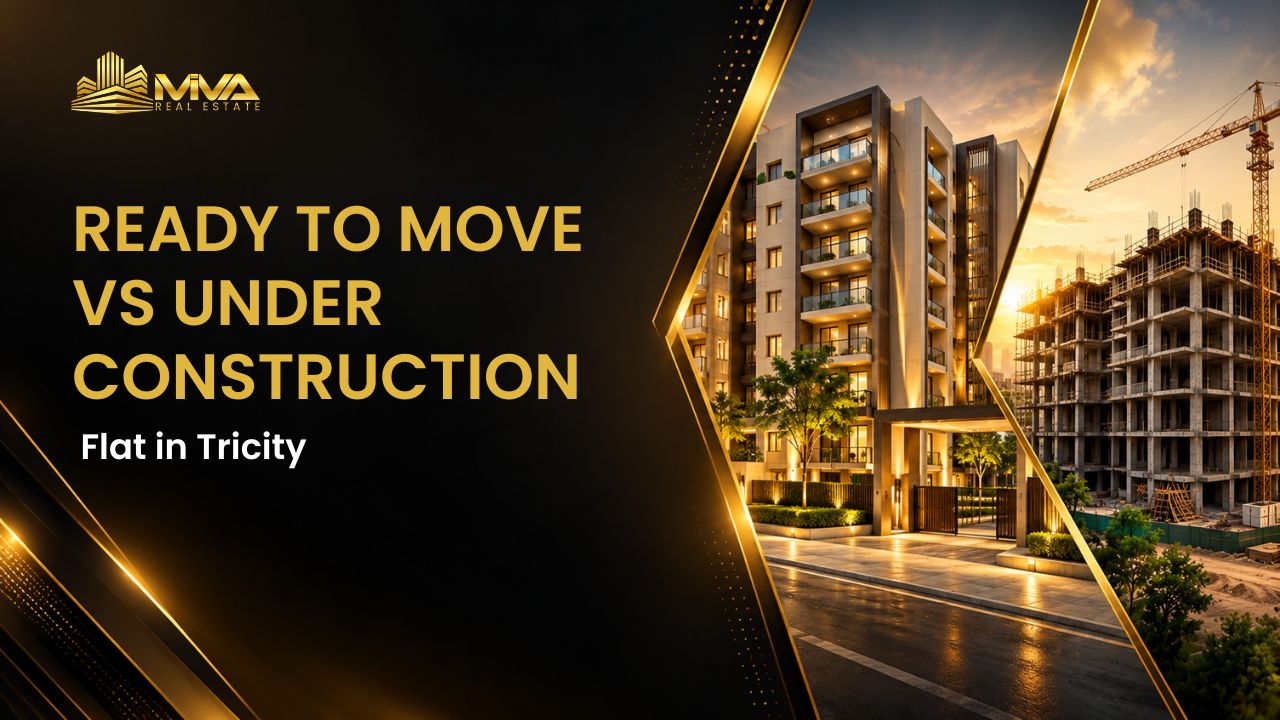
Choosing between a ready to move flat and an under construction flat in Tricity depends on your possession timeline, budget and comfort with risk.
A completed home allows you to inspect the actual property before buying, while a project under construction may offer staged payments and different pricing options. Neither is automatically the better deal.
This guide compares both choices across Mohali, Zirakpur, Kharar, New Chandigarh and Panchkula, including total costs, GST, RERA protection, payment plans and the checks to make before purchasing.
What Does a Ready to Move Flat Mean?
A ready to move flat is a completed residential property available for possession, subject to the necessary legal and occupancy approvals.
Buyers can inspect the actual layout, fittings, ventilation and surrounding facilities before purchasing. However, a finished building does not automatically mean all approvals are complete.
Before buying ready to move flats in Tricity, verify the completion and occupancy documents applicable to the project, title records and possession terms.
What Is an Under Construction Flat?
An under construction flat is a residential property that has not yet reached completion. It may be at the launch, structural or finishing stage.
Buyers select a property using approved plans, project specifications and the agreement for sale. Payments follow the agreed schedule, while possession depends on the project’s progress and contractual commitments.
Ready to Move vs Under Construction: Side-by-Side Comparison
Ready-to-move and under-construction flats differ in cost, possession timelines and risks. Compare the key factors below to find the right option for your needs.
| Feature | Ready to move flat | Under construction flat |
| Possession | After completion of required formalities | As specified in the agreement, subject to completion |
| Price | May carry a premium for immediate availability | May offer lower launch pricing |
| Payment | Usually most of the price near purchase | Upfront and staged payments, depending on plan |
| GST | Generally not applicable when the completed-property sale satisfies GST conditions | Usually 5%, or 1% for eligible affordable housing |
| Construction risk | Lower, but defects and approval issues remain possible | Exposure to delays, changes and incomplete delivery |
| Inspection | Actual property | Plans, specifications and available site work |
| Rent and EMI | Depends on the buyer’s move-in date | May overlap during construction |
Advantages of Ready to Move Flats in Tricity
- No guesswork — check room sizes, sunlight, ventilation, water pressure and fittings before you pay
- Move in straight away — stop paying rent from the month you shift, a big saving for families relocating for work or school
- Lower construction uncertainty — The property is already built, although legal handover and approvals still need checking.
- Financing options — Completed properties may be easier to assess, but loan approval and EMI timing depend on the lender.
- See the neighbourhood as it is — meet residents and check the roads, markets, schools and traffic before deciding
Drawbacks of Ready to Move Flats
- Possible price premium — Some completed homes cost more because possession is available sooner.
- Limited choice — the best floors, corners and views are often sold early
- Possibly dated design — layouts and fittings may feel older if the project took years to finish
- A big upfront payment — you need strong savings or a larger loan within a short time
Advantages of Buying a Flat Under Construction
- Potential launch pricing — Early-stage projects may offer lower prices than comparable completed properties.
- Pay in parts — staged payments give you time to arrange funds
- First pick of units — choose your preferred floor, facing and view
- Modern amenities — newer projects often include clubhouses, play areas, gyms and green spaces
- Room for appreciation — if the area develops during construction, your flat may gain value, though this is never guaranteed
Risks of an Under Construction Flat
- Possession delays — Construction delays can extend rent, pre-EMI or EMI commitments.
- Project interruptions — Financing, approval or construction problems can delay or suspend work.
- GST on top — tax adds to your total cost (see the tax section below)
- Plan vs reality gaps — room sizes, views or finishing quality can differ from the brochure
How Payment Works: Construction-Linked vs Possession-Linked Plans
For a ready to move flat, most of the purchase price is usually paid around registration or possession. Home loan repayments begin according to the lender’s terms, which may not match your move-in date.
For an under construction flat, builders usually offer one of two plans:
- Construction-linked plan (CLP): Payments are linked to construction milestones. Banks may disburse loans in stages, while pre-EMI or full EMI depends on the loan terms.
- Possession-linked plan (PLP) — you pay a small amount at booking and most of the price at possession. It’s often marketed as “pay later”, so compare the total price with the CLP option before choosing.
Budget tip: Compare the total payable amount, interest during construction and the impact of possible possession delays—not just the booking amount.
Your Real Budget: Costs Beyond the Base Price
The base price is only part of what you’ll pay. Before you shortlist, add up:
- Base price of the flat
- GST, for an under construction flat
- Stamp duty and registration charges
- Car parking, clubhouse and maintenance deposits
- Home loan processing fees
- Rent you may keep paying if possession is delayed
Quick example: on an under construction flat with a base price of ₹60 lakh, 5% GST alone can add up to ₹3 lakh. Then stamp duty, registration and deposits come on top, so your final cost can be noticeably higher than the brochure price.
GST, Stamp Duty and Tax Benefits Explained
- GST: Under the standard residential construction scheme, the effective rate is 5%, or 1% for eligible affordable housing. The affordable category generally requires a qualifying carpet area and a property value not exceeding ₹45 lakh. A completed-property sale is generally outside GST when the entire consideration is received after the completion certificate or first occupation, whichever is earlier.
- Stamp duty and registration: Both property types attract applicable charges. Rates depend on the property’s location, ownership structure and current Punjab or Haryana rules.
- TDS on purchase: For a resident seller, 1% TDS generally applies when the consideration or stamp duty value reaches ₹50 lakh. Relevant transactions under the Income-tax Act, 2025 use the prescribed reporting procedure, including Form 141 from April 2026.
- Home loan tax benefits: Deductions depend on the tax regime, property use, loan conditions and applicable limits. Eligible pre-construction interest may be claimed after completion under the relevant rules.
Check transaction-specific tax treatment before making a payment.
RERA Protection for Tricity Homebuyers
The Real Estate (Regulation and Development) Act, 2016 provides important safeguards for homebuyers.
- Project registration: Developers must register projects covered by RERA before advertising or selling, subject to statutory exemptions.
- Separate project account: At least 70% of the amounts realised from allottees must be deposited into a designated account for prescribed land and construction expenses.
- Advance payments: Developers cannot collect more than 10% of the apartment cost before entering into the required registered agreement for sale.
- Carpet area: The agreement must disclose the RERA-defined carpet area, including internal partition walls but excluding specified external spaces.
- Possession delays: Eligible buyers can seek statutory remedies, including refund with interest or delay interest, depending on their circumstances.
- Defect liability: Specified structural, workmanship, quality and service defects reported within five years of possession are covered by the Act.
For project verification, use Punjab RERA for Mohali, Zirakpur, Kharar and New Chandigarh, and Haryana RERA for Panchkula.
Checking a Project on RERA in 5 Steps
- Ask the builder for the project’s RERA registration number. It should be on the brochure, website and agreement.
- Search for it on the correct state portal.
- Confirm the project name, builder and location match exactly.
- Review the approved plans, promised completion date, progress updates and any complaints.
- Make sure the registration is still valid and hasn’t expired.
Other Approvals to Request from the Builder
- Approved building plan from the local development authority
- Land title documents, and change of land use where applicable
- Environmental and fire clearances, for larger projects
- List of banks that have approved the project for home loans
Mohali, Zirakpur, Kharar, New Chandigarh or Panchkula: Which Area Fits You?
Each location offers different residential environments, connectivity and housing choices. Compare individual projects rather than assuming one area is always cheaper or better.
- Mohali: Consider established residential sectors for existing facilities and newer developments for additional housing options. Compare commute times, schools and possession status.
- Zirakpur: Evaluate highway connectivity, airport access, daily traffic and surrounding construction before choosing a project.
- Kharar: Compare total property costs, flat sizes, road connectivity and neighbourhood infrastructure. Lower advertised prices do not always mean lower overall expenses.
- New Chandigarh: Review planned infrastructure, current facilities, construction progress and the delivery commitments of individual projects.
- Panchkula: Compare established residential sectors with newer developments, focusing on access to services, building quality and approved occupancy.
- Chandigarh: If living within the city is important, compare available residential options with properties in nearby towns.
Buyer tip: Visit shortlisted locations during peak traffic hours and verify the project’s exact address, approvals and infrastructure before making a decision.
Use this as a starting point, then visit each area yourself before deciding.
GST, Stamp Duty and Tax Benefits Explained
- GST: Under the standard residential construction scheme, the effective rate is 5%, or 1% for eligible affordable housing. The affordable category generally requires a qualifying carpet area and a property value not exceeding ₹45 lakh. A completed-property sale is generally outside GST when the entire consideration is received after the completion certificate or first occupation, whichever is earlier.
- Stamp duty and registration: Both property types attract applicable charges. Rates depend on the property’s location, ownership structure and current Punjab or Haryana rules.
- TDS on purchase: For a resident seller, 1% TDS generally applies when the consideration or stamp duty value reaches ₹50 lakh. Relevant transactions under the Income-tax Act, 2025 use the prescribed reporting procedure, including Form 141 from April 2026.
- Home loan tax benefits: Deductions depend on the tax regime, property use, loan conditions and applicable limits. Eligible pre-construction interest may be claimed after completion under the relevant rules.
Check transaction-specific tax treatment before making a payment.
Is a Resale Flat a Better Middle Path?
A resale flat is purchased from an existing owner rather than directly from the developer. Buyers can inspect a completed property’s condition and may be able to take possession after the required legal formalities.
Before paying a booking amount, verify the ownership history, existing loans, applicable occupancy approvals, pending maintenance dues and building conditions. GST treatment depends on the nature and timing of the transaction.
Can We Sell an Under Construction Flat Before Possession?
An under construction flat may be transferred before possession if the allotment agreement, developer’s conditions and applicable law permit it.
Before transferring your rights:
- Review the agreement: Check assignment restrictions, lock-in periods and unpaid installments.
- Ask about developer approval: A no-objection certificate or formal transfer process may be required.
- Confirm transfer charges: Check the developer’s applicable fees and payment conditions.
- Check outstanding loans: Obtain the lender’s consent or arrange loan settlement where necessary.
- Review taxes and duties: The tax treatment depends on the rights transferred, holding period and transaction details.
Obtain legal and tax advice before signing a transfer agreement or accepting payment.
Which Option Is Right for You?
There’s no universal winner. It comes down to time, money and trust.
Pick a Ready to Move Flat If You
- Need to move soon for a job, children’s school or family reasons
- Want to stop paying rent as quickly as possible
- Prefer a completed property with possession approvals
- Have the savings or loan approval to pay in full
Pick an Under Construction Flat If You
- Can wait until the contractual possession date and manage possible delays
- Want a lower entry price and staged payments
- Have checked the builder’s delivery record and the project’s RERA details
- Are buying partly as an investment, and accept that price growth isn’t guaranteed
Pre-Purchase Checklist for Tricity Buyers
Before Buying Ready to Move Flats
- Completion and occupancy certificates — the occupancy certificate (OC) confirms the building is approved for people to live in
- Clear title — proof that the seller legally owns the property and can sell it
- Utilities — water supply, power backup and parking allocation
- Dues — confirm there are no pending maintenance or society dues
- Visit twice — see the flat in daylight and after dark to judge light, noise and safety
Before Booking a Flat Under Construction
- RERA details — registration number, approved plan and promised date, using the steps above
- Builder track record — visit their completed projects and speak to residents about delays and quality
- The agreement — read every clause, especially payment terms, delay compensation and cancellation charges
- Payment plan — know exactly what’s due at each stage
- Site visit — check that work on site matches the progress the builder claims
- Snag check at possession — inspect the finished flat carefully and get defects listed and fixed before you sign the possession letter
Mistakes Tricity Homebuyers Should Avoid
Buying a home in Tricity requires careful planning beyond price and location. Avoid these common mistakes to protect your investment and make a more informed property decision.
- Chasing the lowest price — a cheap deal from an unreliable builder can become the most expensive mistake you make
- Budgeting on the base price alone — GST, stamp duty, parking and deposits can add a lot
- Rushing because of limited-time offers — Never skip legal and financial checks because of sales pressure.
- Trusting verbal promises — if it isn’t written in the agreement, it doesn’t count
- No RERA details — The developer cannot provide a valid registration number for a project that legally requires registration, or cannot explain a claimed exemption.
Warning Signs to Walk Away
- No RERA number, or one that doesn’t match the project
- Requests for large cash payments, or bookings without a written agreement
- Pressure to pay immediately “before prices go up”
- A completion date that keeps moving with no written explanation
- A sample flat that looks very different from the approved plan
Conclusion
Both ready to move flats and under construction flats can suit Tricity buyers, but they serve different needs.
A completed home may suit buyers seeking an earlier move-in date and the opportunity to inspect the property. A project under construction may appeal to buyers who can manage staged payments, construction timelines and associated risks.
Compare the total cost, legal approvals, builder’s track record and possession conditions before deciding. The better choice is the property that fits your finances and plans—not simply the one with the lowest advertised price.
Frequently Asked Questions
1. Can I make changes to a ready to move flat after buying it?
Yes. Buyers can generally make non-structural changes, such as painting or replacing interior fittings, subject to society rules. Structural alterations or changes to shared areas may require approvals from the appropriate authority.
2. Can I negotiate the price of ready to move in apartments?
Yes, negotiation may be possible with developers or resale sellers. Depending on the property, buyers can discuss the price, payment terms or certain additional charges. Discounts are not guaranteed.
3. Is GST charged on parking and maintenance?
Parking charges connected to a property purchase may be taxable depending on the transaction. For eligible residents’ welfare associations, maintenance contributions up to ₹7,500 per month per member may qualify for exemption. Higher contributions can have different GST treatment.
4. What happens if the builder changes the layout of an under construction flat?
Under RERA, changes to an individual apartment’s sanctioned plans or specifications generally require the buyer’s prior consent, subject to permitted minor changes. Changes to common areas or building plans may require consent from at least two-thirds of the affected allottees. Buyers can seek remedies where applicable.
5. Can I rent out a ready to move flat immediately after purchasing it?
Yes, you can generally rent out a ready to move flat once ownership and possession formalities are complete. However, check the society’s rules, applicable rental requirements and any restrictions in the property documents before finding a tenant.
Find the Right Flat in Tricity
Comparing ready to move flats with under-construction projects in Mohali, Zirakpur, Kharar, New Chandigarh or Panchkula?
MIVA India can help you shortlist available properties based on your budget, preferred location and possession timeline.